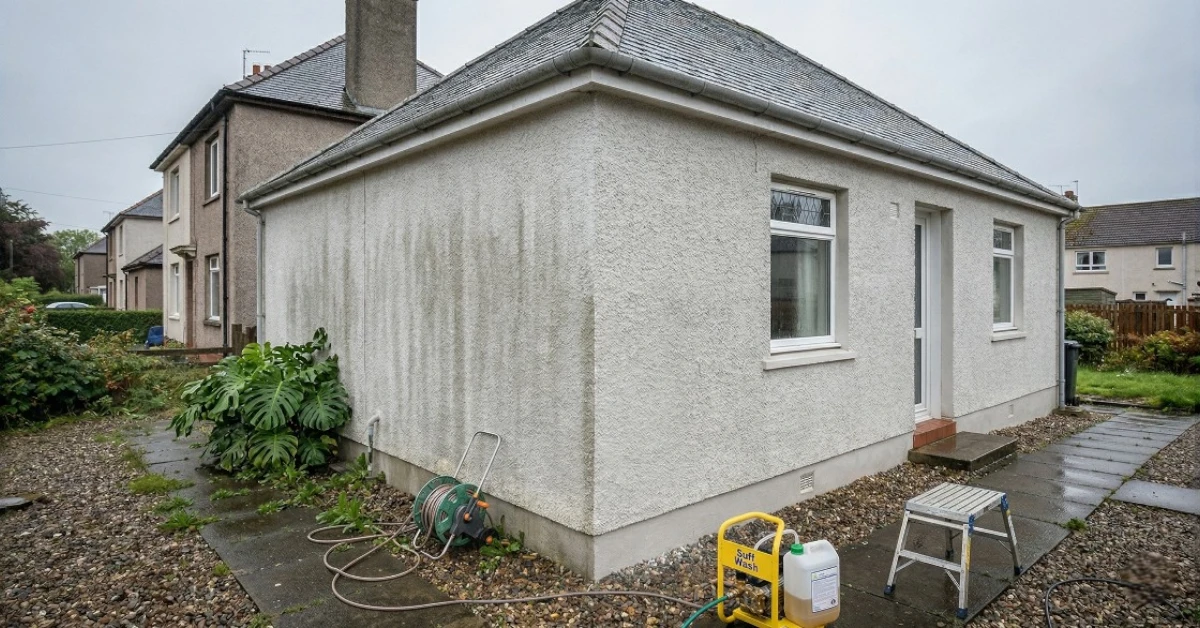
If your home has roughcast render, you already know it does not stay clean for long. The textured surface grabs onto everything — moss spores, algae, black mould, traffic grime — and holds it in a way that smooth render or brick simply does not. After a Fife winter, a north or west-facing roughcast wall can look like it has not been touched in years, even if it was cleaned the previous spring.
This is not a cosmetic problem you can ignore. Left untreated, biological growth works into the render surface, and the same freeze-thaw cycles that hammer Fife every winter gradually open up microcracks. What starts as a dirty-looking wall can become a maintenance issue that costs significantly more to fix than a regular clean would have.
Why Roughcast Is So Common in Fife
Roughcast — sometimes called wet dash or pebble dash depending on the aggregate mix — became the standard exterior finish on Scottish housing from the early 20th century onward. Walk down any street in Kirkcaldy, Glenrothes, Cowdenbeath, or Lochgelly and the majority of pre-1980s houses will have it. It was chosen for a reason: the thick, textured coating handles Scottish rainfall and wind better than smooth render. It breathes, it is durable, and it takes paint reasonably well when repointed.
The downside is that same texture. Every bump and recess in the surface is a ledge where organic matter can settle and begin to grow. In Fife's climate — high annual rainfall, limited winter sunlight, and coastal damp — surfaces rarely fully dry between October and March. That sustained moisture is exactly what moss and algae need.
What You Are Actually Dealing With
The staining on roughcast is rarely just one thing. Most properties show a combination of:
- Green algae — the most common, forms a slippery film and spreads fast in damp conditions
- Black mould and lichen — harder to shift, often embedded into the surface texture rather than sitting on top
- Orange and rust staining — usually from iron in the aggregate or from corroded fixings above (satellite brackets, guttering screws)
- Efflorescence — white salt deposits drawn out of the render by moisture movement, common where there has been water ingress
- Moss — builds up in sheltered corners and along the base of walls, retains moisture and accelerates the freeze-thaw damage cycle
Properties close to the coast — Burntisland, Kinghorn, Dysart, Aberdour — deal with an additional factor: salt-laden air from the Forth deposits a fine residue on all exposed surfaces. This speeds up both biological growth and surface degradation on render that is not cleaned regularly.
The Right Way to Clean Roughcast Render
Roughcast requires a more careful approach than block paving or a concrete driveway. The surface is porous and the aggregate can be knocked loose if high-pressure washing is done incorrectly. There are three stages to doing it properly.
1. Pre-treatment with a biocide
A quality fungicidal or algaecidal treatment applied before any washing is the single most effective step. It kills the biological growth at the root rather than just blasting the surface layer off. Left for 24–48 hours, a good biocide will penetrate the texture and break down moss and algae so they release cleanly. Skipping this step and going straight to pressure washing often just spreads live spores across the wall and around the property.
2. Low-to-medium pressure soft washing
Roughcast should never be cleaned at the same pressures used on hard paving. The force needed to blast decades of algae off block paving will erode the surface of render, dislodge the aggregate, and can drive water behind the finish if there are any existing hairline cracks. Soft washing — a lower-pressure rinse combined with appropriate cleaning solution — removes the treated growth without damaging the substrate.
This is where experience matters. Knowing how close to hold the lance, what angle to work at, and how to handle corners, window reveals, and areas around fixings comes from doing this work regularly — not from hiring someone with a domestic pressure washer who has never worked on render before.
3. Post-treatment protection
A second application of biocide after cleaning leaves a residual barrier that slows regrowth significantly. On a well-maintained property this can extend the time before the next clean is needed by 12–18 months.
What to Avoid
A few things that cause unnecessary damage to roughcast render:
- High-pressure rotary nozzles — the concentrated force strips aggregate and leaves visible scarring on the surface
- Cleaning in freezing conditions — water driven into porous render at near-zero temperatures can cause immediate frost damage; always work above 4°C
- Bleach-based household cleaners — effective short-term but they can bleach out colour variation in the render and break down the surface over repeated applications
- Pressure washing without pre-treatment — this pushes live organic matter into the render rather than removing it
How Often Does Roughcast Need Cleaning in Fife?
For most Fife properties, a full clean every 2–3 years is realistic. North and west-facing elevations in coastal areas like Kirkcaldy KY1–KY3, or in sheltered spots with tree coverage, will need attention every 18 months to 2 years. South-facing walls in more exposed positions — where wind and sun do some of the work — can often go three years without significant regrowth.
The tell is simple: if the render has gone from its original colour to noticeably green, grey, or black, it is past due. At that point the biological growth is established enough that it will begin working into the surface rather than just sitting on it.
For more on how we approach exterior wall washing alongside driveway and patio work, see our pressure washing service page. If you are also dealing with stained or blocked guttering — which is common on properties where the render has been neglected — our gutter cleaning service is often carried out at the same visit. Fascia boards and soffits that run along the roofline also benefit from being cleaned at the same time: see soffit and fascia cleaning for details.
The Historic Environment Scotland guidance on traditional renders is worth reading if you have an older property where the roughcast may be lime-based rather than cement — the cleaning approach needs to be adjusted accordingly.
What Does It Cost?
Roughcast cleaning is priced by the elevation — the size of the wall, the level of soiling, and how accessible it is. A standard semi-detached with two or three elevations to clean typically takes a half-day. We quote after a site assessment because roughcast jobs vary more than most: a lightly soiled wall on a new-build is a different job to a heavily colonised gable end on a 1930s terrace in Dysart.
What we can say is that leaving it longer always costs more. A wall cleaned regularly is quick work. A wall that has not been touched for five years needs more time, more product, and sometimes two visits if the first biocide treatment needs longer to work through heavy growth.
Get a Quote for Roughcast Cleaning in Fife
We cover all of Fife — Kirkcaldy, Dunfermline, Glenrothes, Leven, Cupar, St Andrews, Burntisland, Kinghorn, Cowdenbeath, Lochgelly, Inverkeithing, Aberdour, and surrounding areas. With over 22 years of experience cleaning properties across the region, we know what Fife render deals with and how to handle it properly.
Call 07572 454128 or send us a message to arrange a free quote. We are usually able to visit within a few days and most render cleans can be completed in a single visit.
Need a quote?
Free quotes across all of Fife. We respond within a few hours — usually much faster.
Get a Free Quote07572 454128